













How to systematically generate and validate business ideas that actually work?
In brief:
- Systematic idea generation focuses on observable behavior patterns rather than abstract problems
- 4 main sources of viable ideas include copying successful models, community communication, personal experience, and complementary products
- Product-channel fit should be achieved before product-market fit through Excel forecasting
- Market strategies depend on growth rate: expanding markets need broad presence, mature markets require competitive differentiation
- Success comes from treating ideas as hypotheses to test, not final solutions to build
Generation of business ideas isn’t magic—it’s a systematic process. 99% of startups fail precisely because they’re based on single hypotheses. This article shows how to find dozens of viable ideas and validate them before launch, turning entrepreneurial intuition into repeatable methodology.
Why 99% of New Projects Fail
99% of new projects die because entrepreneurs put all their eggs in one basket. The fundamental mistake is treating an idea as a final solution rather than a hypothesis to test.
That’s why there should be not only one win option, but a large list of possible solutions. In my experience, the best approach to an idea is not to define the client’s abstract problem, but to define WHY I want to do something in simpler language.
Ideas work best when they’re rooted in observable human behavior rather than theoretical market gaps.
What Makes Ideas Actually Viable?
Good ideas are more like life observations. They emerge from watching how people actually behave, not how we think they should behave.
4 Types of Observable Human Problems
Behavioral Paradoxes: People want to be unique but follow trends Example: “Many people like to wear things that are not like others wear”
Ritual Avoidance: Common activities people consistently try to escape Example: “Most people eat at home but don’t like to wash dishes after themselves”
Intention-Action Gaps: Disconnect between what people want and what they do Example: “Many people would like to keep fit, but they don’t have the patience to go to a fitness club regularly”
Logistical Imbalances: System inefficiencies that create daily friction Example: “It is not convenient for people who travel around the city during the day to meet the courier at the specified address at an incomprehensible period of time”
The solution to each of these problems can be a whole list of different options. This is the key to increasing the number of hypotheses and attempts.

What Are the 4 Main Sources of Viable Ideas?
1. Global Market Arbitrage
Copying successful companies and projects from other markets works consistently. Y Combinator demonstrates this pattern every year: B2B Enterprise SaaS, NoCode for minor business functions, Uber-model applications in emerging markets.
Why it works: Proven business models reduce execution risk while geographic arbitrage provides competitive advantage.
2. Community Intelligence
Viable ideas are born through communication with new people and within your local community. The best insights emerge in conversations at conferences, meetups, and industry events—not in office rooms.
Why it works: Real problems surface in casual conversations where people share genuine frustrations without sales pressure.
3. Personal Pain Points
Your own money-spending experience reveals authentic market needs. The most successful entrepreneurs solve problems they personally experience and understand deeply.
Why it works: Personal experience provides unique insights into customer psychology and willingness to pay.
4. Ecosystem Complementarity
Becoming a complementary product for a “bestseller giant” creates immediate market access. Micro SaaS solutions—extensions, plugins for CRM, Shopify apps, chatbots—represent billion-dollar markets.
Why it works: Established platforms provide built-in distribution and validated customer bases.
How to Transform Ideas into Testable Products?
A product is a specific way to implement your idea. We should try different approaches until we find one that works.
The Implementation Reality Check
There is usually no equality between the phrases “what we do” and “what people buy.” Based on Philip Kotler’s insight—”people don’t buy a drill, they buy a hole in the wall”—the sooner we start selling to customers instead of developing platforms, the sooner we get the answers we need.
Before talking about product/market fit, it’s better to achieve product/channel fit first. The next step is to forecast and calculate everything in Excel before putting any money into advertising.
How to Build a Marketing Forecast Model?
The Complete Funnel Formula
Market × Ads × Converter × Sales × Finance = Profit
| Stage | Key Question | Optimization Focus |
|---|---|---|
| Market | How many people spend money on existing solutions annually? | Market size validation |
| Ads | Which channels can reach target customers and generate clicks? | Channel selection and reach |
| Converter | How many leads come from clicks? | Landing page and funnel optimization |
| Sales | How many sales does the team close from leads? | Sales process and qualification |
| Finance | What’s the profit after taxes and operational costs? | Unit economics and scaling |
This approach reveals key optimization points in the formula. The biggest improvements always come from conversions between funnel stages.
What Market Strategies Actually Work?
Strategy Selection Based on Market Growth
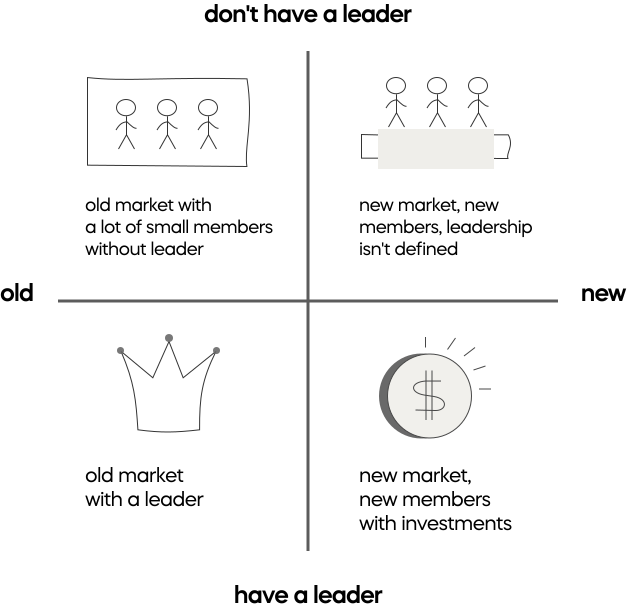
Growing Markets (30%+ annual growth): Our advertising should be everywhere. When markets double every few years, many new customers enter continuously. The strategy focuses on capturing market expansion rather than competing for existing customers.
Mature Markets (under 30% growth): Need to lure customers from competitors. The only viable strategy is taking customers from existing players. To succeed, you need to be 2-10 times better in criteria that matter to consumers.
Market Entry Approach
- Step 1: Choose markets without dominant leaders when possible
- Step 2: Act differently from others in marketing and sales approaches
- Step 3: Become a separate category for buyers to avoid direct competition copying
What Are the 7 Unfair Competitive Advantages?
Understanding competitive advantages helps startups focus on winnable battles from day one.
The Complete Advantage Framework
| Advantage Type | Description | Startup Viability |
|---|---|---|
| Brand | Customer preference based on reputation | ❌ Takes years to build |
| Switching Costs | Difficulty customers face changing providers | ❌ Requires market dominance |
| Exclusive Resources | Unique access to talent, data, or materials | ✅ Available to startups |
| Network Effects | Product value increases with more users | ❌ Requires scale |
| Scale Economies | Cost advantages from large operations | ❌ Requires significant capital |
| Counter-positioning | Serving segments incumbents can’t address | ✅ Available to startups |
| Process Power | Operational excellence competitors can’t replicate | ❌ Takes time to develop |
Startup Reality Check
Startups usually have only 2 advantages available at the beginning:
- Exclusive resources and talents: Unique access to data, technology, or domain expertise
- Counter-positioning: Serving market segments that established players cannot or will not address
Focus on these two advantages when building your initial competitive strategy.
Validation Checklist for New Ideas
✅ Observable Behavior Pattern
- Can you point to specific examples of people demonstrating this problem?
- Is this based on what people actually do, not what they say they want?
✅ Multiple Solution Paths
- Have you identified at least 3-5 different ways to solve this problem?
- Are you testing the simplest version first?
✅ Channel-Product Fit
- Do you know exactly how to reach these customers?
- Have you calculated the unit economics in Excel?
✅ Competitive Positioning
- Which of the 7 advantages can you realistically build?
- Are you entering a growing market or fighting for existing customers?
Ready to transform your business ideas into systematic opportunities? At Humanswith.AI, we help entrepreneurs and businesses validate ideas through data-driven market research and AI-powered customer insights. From market analysis to competitive positioning, our team provides the strategic intelligence you need to build ideas that actually work. Visit Humanswith.ai for consultation or explore our Digital Marketing Competitor Analysis services to understand your market before you build.
From Ideas to Systematic Success
The difference between successful entrepreneurs and dreamers isn’t the quality of initial ideas—it’s the systematic approach to testing and refining them. Ideas are hypotheses, not destinations. The goal isn’t to find the perfect idea but to build a repeatable process for generating and validating opportunities.
Start with observable human behavior, test multiple solution paths, and focus on the competitive advantages actually available to startups. Most importantly, validate through real customer conversations and Excel models before building anything complex.
Remember: 99% of projects fail not because of bad ideas, but because of single-bet thinking. Build your idea portfolio like an investor builds a financial portfolio—diversified, tested, and systematically optimized.
Frequently Asked Questions
-
How do I know if my business idea is actually viable?
A viable business idea starts with observable human behavior patterns, not abstract market opportunities. Test viability by identifying specific examples of people demonstrating the problem, calculating unit economics in Excel, and validating at least 3 different solution approaches before building anything.
-
What's the difference between copying and legitimate market arbitrage?
Market arbitrage involves adapting proven business models to new geographic markets, customer segments, or technological platforms. Unlike direct copying, it requires understanding why the original succeeded and how local conditions might require modifications.
-
Should I focus on growing markets or try to compete with established players?
Choose growing markets (30%+ annual growth) when possible, as they allow broader marketing strategies and customer acquisition. Only enter mature markets if you can be 2-10 times better than existing solutions in criteria that matter to customers.
-
How many ideas should I test simultaneously?
Start with 3-5 variations of solving the same observable problem rather than testing completely different problems. This allows you to learn faster about what works while maintaining focus on a specific customer segment.
-
What competitive advantages can startups realistically build?
Startups typically succeed with exclusive resources (unique data, technology, or expertise) or counter-positioning (serving segments established players can't address). Avoid strategies requiring scale, network effects, or brand recognition.
-
How do I validate ideas without building a full product?
Use Excel models to forecast unit economics, conduct customer interviews about existing solutions, test landing pages with different value propositions, and offer manual services before automating them.
-
When should I pivot vs. persist with an idea?
Pivot when you can't achieve product-channel fit after testing multiple approaches, or when unit economics don't work even with optimization. Persist when you're seeing customer engagement but need to refine the solution or pricing model.


 Alex Sukhov