
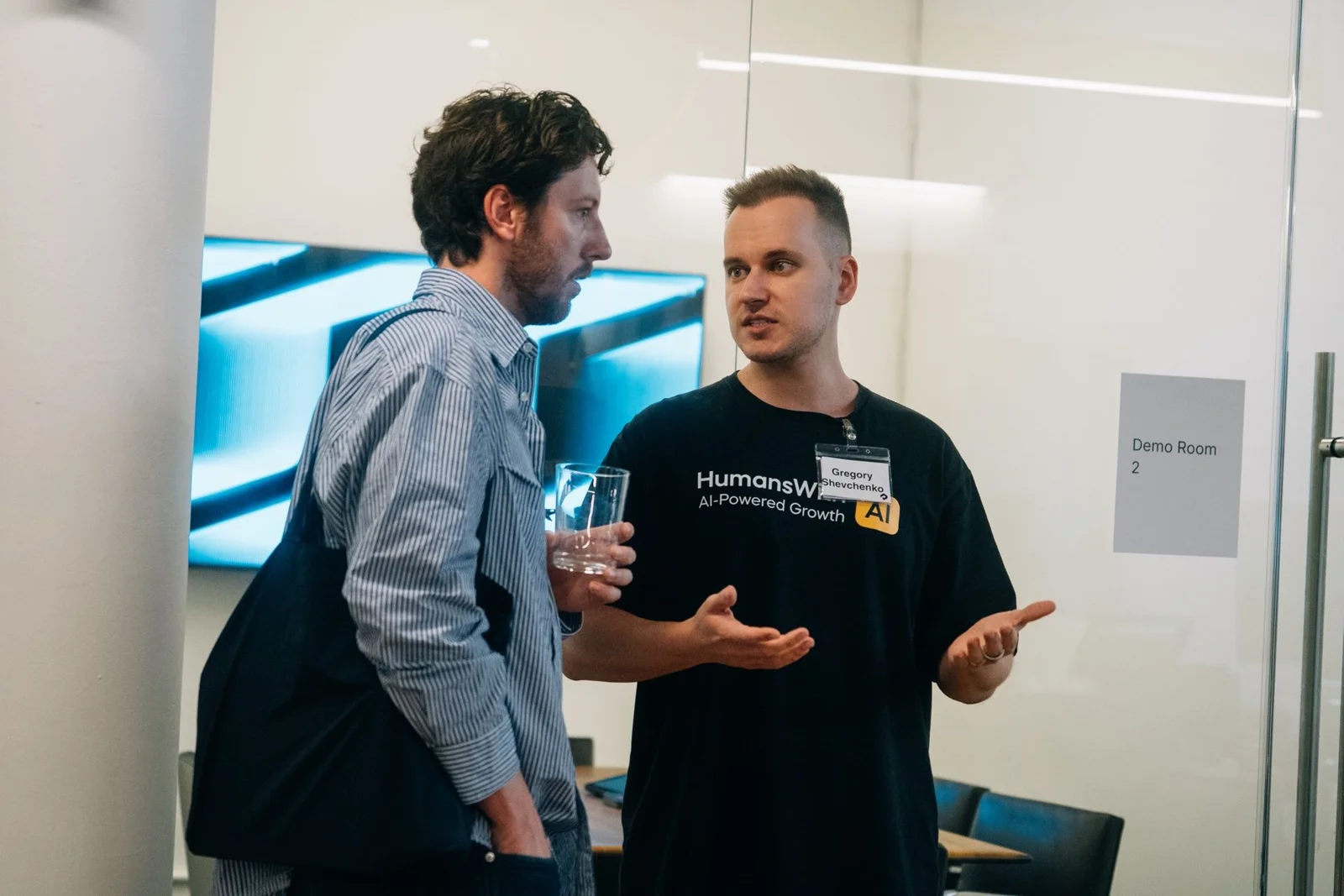
June 6, 2026, 9:45 AM. A loft on Union Square West, fifty people with laptops, a name check at the door. I was one of those fifty. Getting in was already a filter: roughly 1,000 applications for 50 seats — a 1-in-20 acceptance rate [1]. That matters, because the rejection pile included VPs and product leads from companies you would recognize. Selection was global: I flew in from the UAE, and of the fifty people in the room, five of us weren't from the US. The other forty-odd were mostly California, mostly Silicon Valley.
Section 01
What Profound is, and why it ran a hackathon
Profound is a platform for tracking how brands show up inside AI answers. ChatGPT, Perplexity, Gemini, Claude — they generate answers instead of links, and brands need to know where and how they appear in those answers. Founded in 2024, the company raised three rounds in 18 months: a $3.5M seed, a $20M Series A led by Kleiner Perkins (June 2025), a $35M Series B led by Sequoia (August 2025), and a $96M Series C led by Lightspeed (February 2026) at a $1B valuation [2]. By then it counted 700+ enterprise customers — Target, Figma, Walmart, Ramp, MongoDB, Chime, U.S. Bank — more than 10% of the Fortune 500 [3], with 500+ clients using Profound Agents daily.
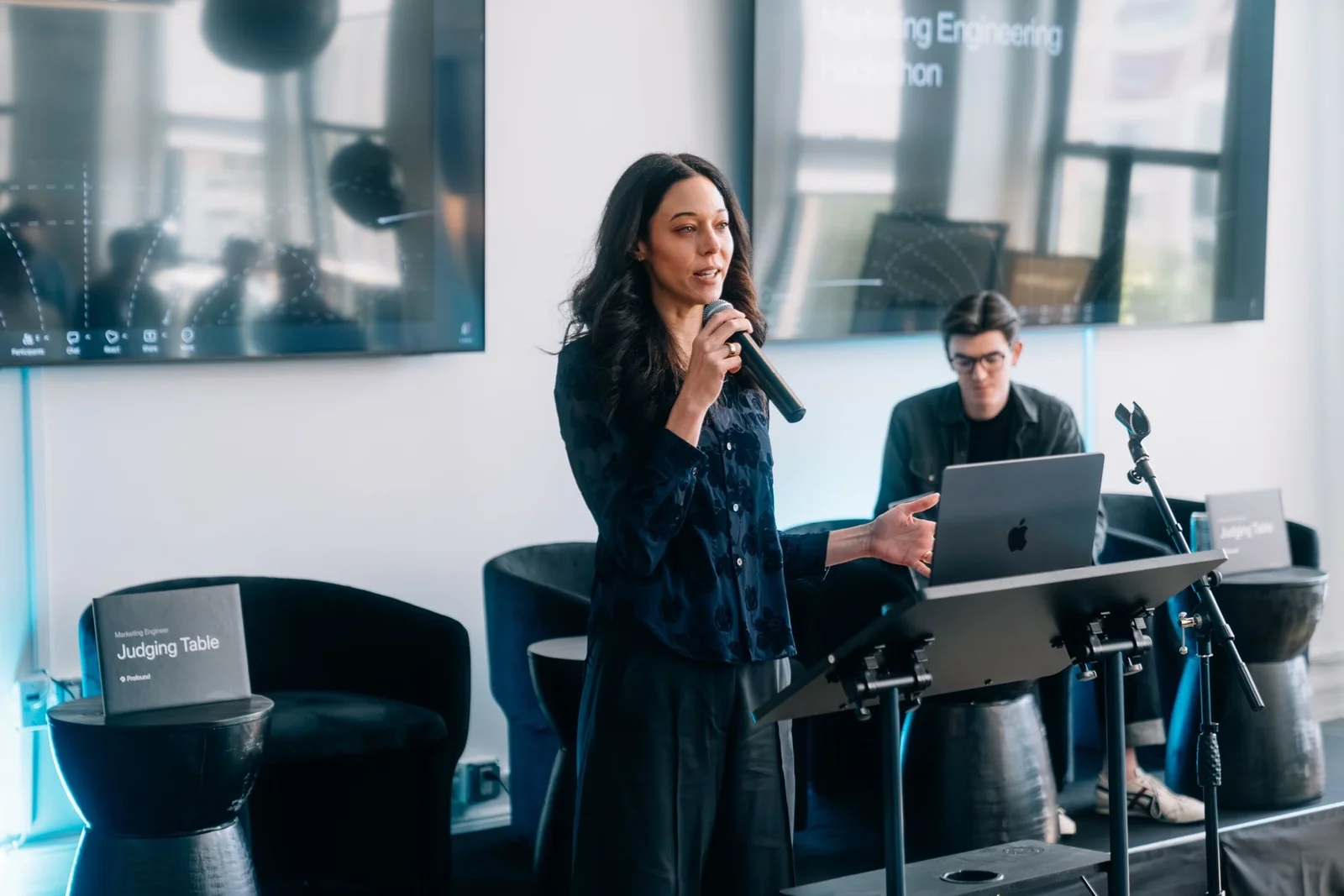
This was the first hackathon in what would become a series. The format: 50 solo builders, one day, open platform, two four-minute demo rounds, $40,000 in prizes [4]. Judges came from Anthropic, Stripe, Ramp, Google, and MongoDB. The brief sounded simple: find a marketing process that's inhuman in scope or scale, and ship a system or an agent that runs it.
Section 02
Who showed up: a Silicon Valley skew
Of the fifty builders, forty-plus were American — predominantly Californian. The five international builders came from Canada, Colombia, the UAE (me), France, and the UK. That's a signal in itself: the AI Search conversation is concentrated in Silicon Valley right now, and the hackathon made that visible. People flew in for a single day — from France, Colombia, Dallas, Chicago — and stayed until the lights went out [5].
But the bigger conversation in the room wasn't geography. It was a job title that doesn't exist yet: the marketing engineer.
Section 03
The marketing engineer: a specialty with no headcount line
Profound didn't name the event "Marketing Engineering" by accident. Marketers were rarely an engineering discipline before. Copywriter, strategist, analyst, product marketer — these roles work with text, plans, and data, not with code and agents. That boundary is dissolving. With tools like Claude Code, Codex, and Cursor, a marketer can now assemble agents that do the work a six-to-ten-person team used to handle.
We were, effectively, the first members of a new role. Most people in that room were already building marketing agents — they just didn't have a name for what they do. The phrase I heard most often that day: "I finally have a way to describe what I do" [5]. That's what it looks like when a specialty gets its name.

Section 04
What I built: three tracks, one agentic workspace
I split the day across three tracks. Claude Code for AI agents on the Profound platform. Codex for the landing site. Cursor for authentication and the native agents outside the Profound platform.
In practice, I stood up our agentic workspace at the hackathon — a marketing-automation platform that replaces a six-person marketing team. At Humanswith.ai we build the operational layer for marketing: not analytics, not a dashboard, a system that does the work. Over the course of the day I assembled 11 agents. The account was shared — 60 agents total from all participants, 11 of them mine.
The market right now is dominated by analytics tools — visibility platforms and data sources that tell you which content to create. But content still has to be unique, grounded in a company's expertise and knowledge base. Operational-automation tooling — systems that don't just show the gap but close it — barely exists. That's what we build: one operator running a platform of AI agents instead of a six-to-ten-person content team. The long-term vision is a fully automated marketing org, one person directing agents across every channel. The task we've shipped first is AI Search.
Section 05
The Profound integration: data, a key, a live demo
I integrated our platform with Profound to run on their data. In the demo I showed how an operator issues an API key and runs the whole system end to end. We demonstrated the first x10 case — one operator with agents doing the work that would take ten times the headcount manually.
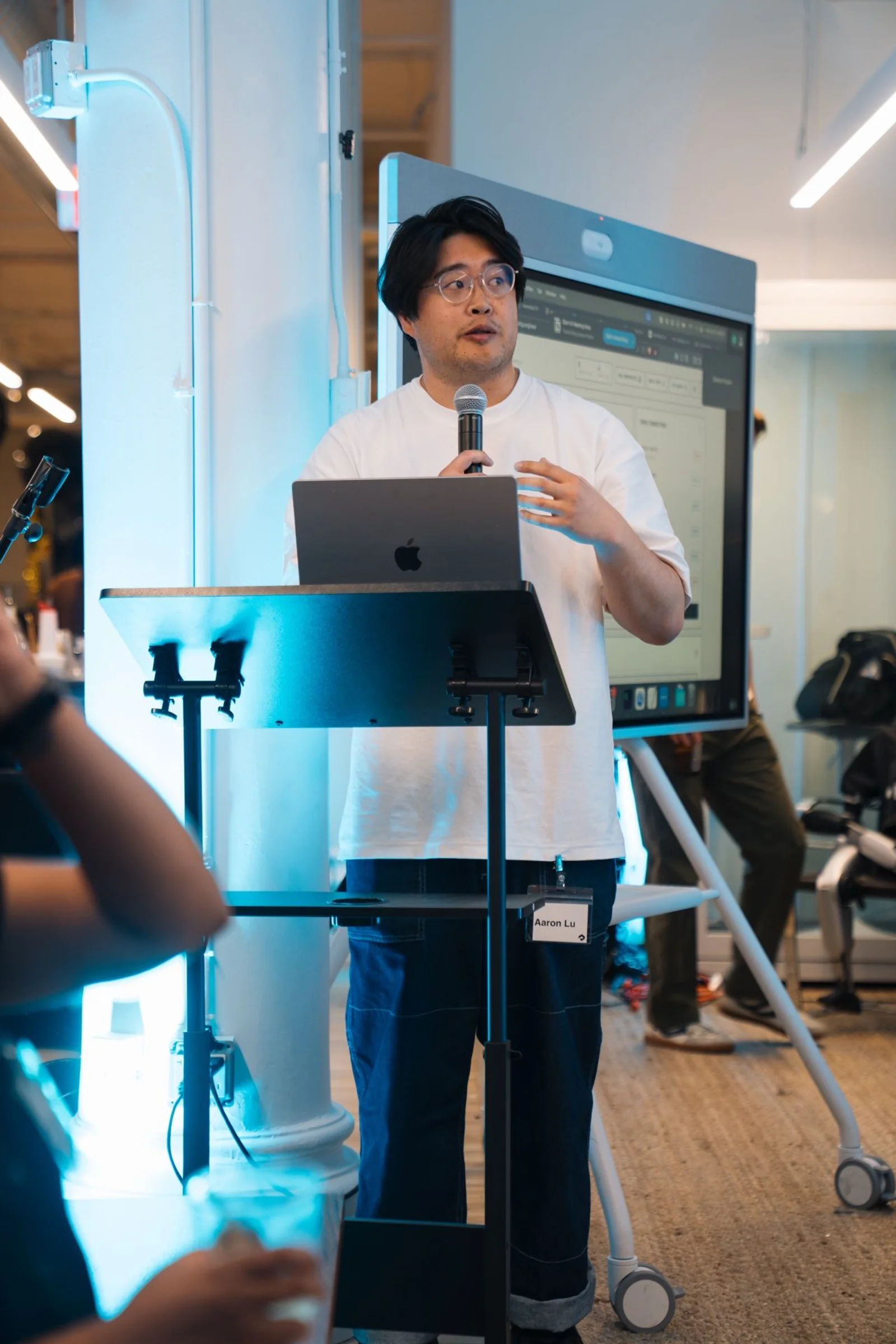
The demo was hands-on: not slides, not a pitch deck, a live run. How a marketing operator issues a key, how agents start working on Profound data, how the output assembles into a packet you can re-verify line by line.
Section 06
Who won
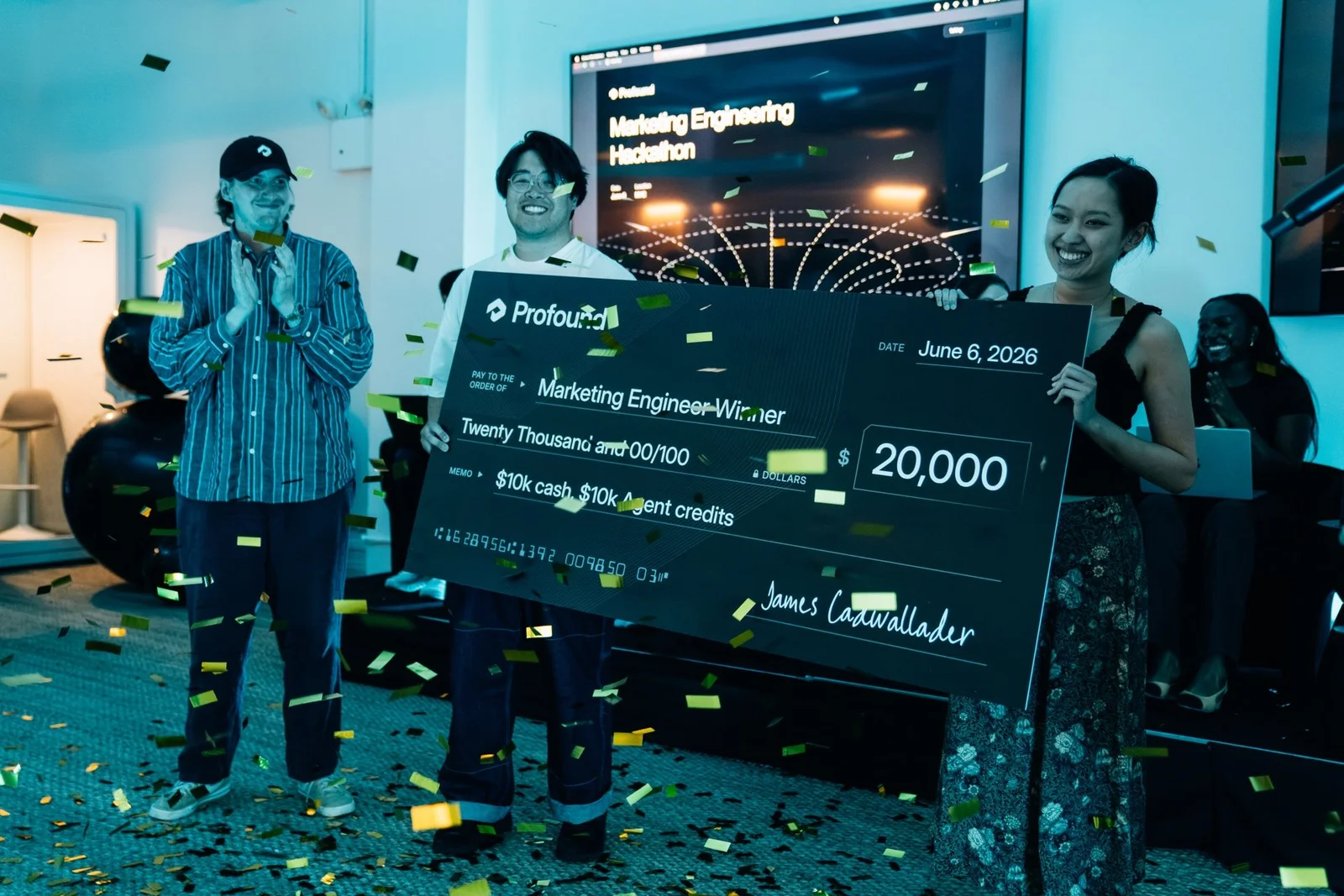
Two builders took the day [5]:
Aaron Lu — AI Product Lead, Growth Marketing at Notion. He built an always-on competitive intelligence agent that monitors competitor pages and ads in real time, surfaces exactly what they're testing, and automatically opens GitHub PRs against your own site. His framing: paid, organic, and answer engines aren't three channels — they're one surface [4].
Brianna Pham — founder of Studio Ascend, a New York growth hacker. She builds agents alongside Nicholas Thorne from Audos and came to test herself. Her project was about turning views into customers through agents that work on content and distribution [6].
Each winner took home $10,000 cash plus $10,000 in Profound Agent credits — and an interview offer at Profound [4].
Section 07
Where companies get it wrong
Most tools on the market are analytics. They show you where your brand is invisible inside AI answers — and then do nothing about it. Companies buy a monitoring subscription, see the gaps, and then what? They hire a six-to-ten-person team: copywriters, SEO specialists, editors, analysts, product marketers, designers. That team writes, publishes, measures, rewrites. The cycle takes weeks. In that time, the AI Search landscape shifts.
Operational automation is a different approach. One marketing operator directs agents that do the same work: inspecting prompts, comparing cited sources, turning gaps into source-backed assets, publishing, measuring. The cycle takes hours, not weeks. And every step is verifiable: every claim carries a source, every run leaves a receipt.
The hackathon proved this isn't theory. Fifty people in that room were building exactly this — agents that run marketing processes. Not dashboards, not reports. Working systems.
Section 08
What the day proved
The day's value wasn't the prize. It was that fifty people from different countries and companies were all building the same thing at the same time — marketing agents. That's a marker of the moment: a specialty with no headcount line already has practitioners. Marketing engineer isn't a future role. It's a current one. Companies just haven't written the job description yet.
If you need a breakdown of your brand's AEO and GEO visibility — with a task list and a source under every claim — write to me or the Humanswith.ai team. I won't promise growth numbers in advance. I will promise a packet you can re-verify line by line.
The full photo gallery is on Pixieset [7]. The canonical field note is on gregshevchenko.com [8]. A follow-up: in October 2026 I came back as a returning builder for the second hackathon, in San Francisco — field note and the Conversation Gauntlet build are linked there [9].
Section 09
FAQ
What is the Marketing Engineering Hackathon?
A one-day format run by Profound: 50 selected solo builders ship a marketing system or agent in a single day. The 2026 New York edition ran on June 6 at Profound HQ on Union Square West.
How competitive was admission?
Roughly 1,000 applications for 50 seats — a 1-in-20 selection rate. Selection was global, and the rejected pool included VPs and product leads from well-known companies.
How many participants were from outside the US?
Five of fifty: Canada, Colombia, the UAE, France, and the UK. The rest were predominantly from California and Silicon Valley.
What is an agentic workspace?
A marketing operational-automation platform. Instead of a six-to-ten-person team, one marketing operator runs AI agents that do the work: inspect prompts, produce content, publish, measure. The cycle takes hours, not weeks.
How does operational automation differ from analytics?
Analytics tools show where a brand is invisible in AI answers. Operational automation does something about it: agents create content, publish it, and measure the result. The first is a dashboard; the second is a working system.
Who won the hackathon?
Aaron Lu (AI Product Lead, Growth Marketing at Notion) and Brianna Pham (founder of Studio Ascend). Each received $10,000 cash and $10,000 in Profound Agent credits.
Section 10
Sources
- Profound University — Marketing Engineering Hackathon, NYC, June 6, 2026 — https://university.tryprofound.com/events/marketing-engineering-hackathon 2. Profound — Series C $96M at $1B valuation — https://www.tryprofound.com/blog/profound-raises-96m-series-c 3. SiliconANGLE, February 2026 — $96M Series C at $1B valuation — https://siliconangle.com/2026/02/24/profound-raises-96m-1b-valuation-ai-discovery-monitoring-platform/ 4. Profound LinkedIn — hackathon recap, 50 builders, $40,000 in prizes — https://www.linkedin.com/posts/tryprofound_we-hosted-our-first-marketing-engineering-activity-7469486543552983040-dEIT 5. Nick Lafferty (Profound) — marketing engineers from France, Colombia, SF, global selection — https://www.linkedin.com/posts/nicklafferty_we-threw-our-first-hackathon-for-marketing-activity-7469761372365643776-q4dj 6. Brianna Pham — Studio Ascend, hackathon winner — https://www.linkedin.com/posts/briannapham_this-past-weekend-i-won-profounds-first-ever-activity-7470134807495155713-Rwu6 7. Profound Hackathon NY — official photo gallery — https://profoundzeroclick.pixieset.com/hackathon-ny/highlights/ 8. Gregory Shevchenko — canonical field note — https://gregshevchenko.com/notes/marketing-engineering-hackathon-nyc/ 9. Gregory Shevchenko — SF hackathon field note, October 3, 2026 — https://gregshevchenko.com/notes/marketing-engineering-hackathon-sf-2026/
For your team
Stop hiring agencies and freelancers
Hire not agencies and freelancers — but Marketing AI Agents for the AI Search.
- Per-engine citation map across 9 AI engines
- Content + schema work that earns the citation
- Honest 30-min strategy call before you commit
Cited across
- ChatGPT
- Claude
- Perplexity
- Gemini
- Grok
- DeepSeek
- Kimi
- Google AIO
- Copilot