Marketing Agent 01 · observe · decide
See what the engines returned. Decide what deserves action.
The first preserves comparable responses and source evidence. The second normalizes the record, ranks opportunities, and hands an approved next action to the rest of the workspace.
Observation contract
Prompt · engine · region · language · source state · timestamp
Two layers, one record
Observation is evidence. Prioritization is a decision.
It stores the prompt, engine, region, language, answer state, exposed source links, and observation time without pretending the sample is the whole market.
It compares like with like, distinguishes citations from mentions, and ranks opportunities against the declared goal and authority.
No page is created and no site is changed until a person approves the evidence boundary and the proposed action.
What the agent returns
A traceable visibility record. Not a single magic score.
Observation
Prompt-and-engine record
The exact prompt, engine, region, language, response state, and observation time stay attached to the record.
Evidence
Mention and citation split
A mention and a citation are stored as different signals, with visible source URLs where the engine exposes them.
Context
Comparable watch set
Brand and competitor observations use the same declared scope before deltas are interpreted.
Decision
Ranked opportunity
AI Visibility Intelligence translates repeated observations into a bounded next-action recommendation.
Handoff
ContentOS-ready packet
Accepted opportunities carry prompt intent, evidence, source requirements, expected snippets, and acceptance criteria.
Follow-up
Checkpoint plan
The canonical URL, prompts, engines, regions, languages, and follow-up dates remain part of the same record.
Workspace · AI Visibility · Prompts
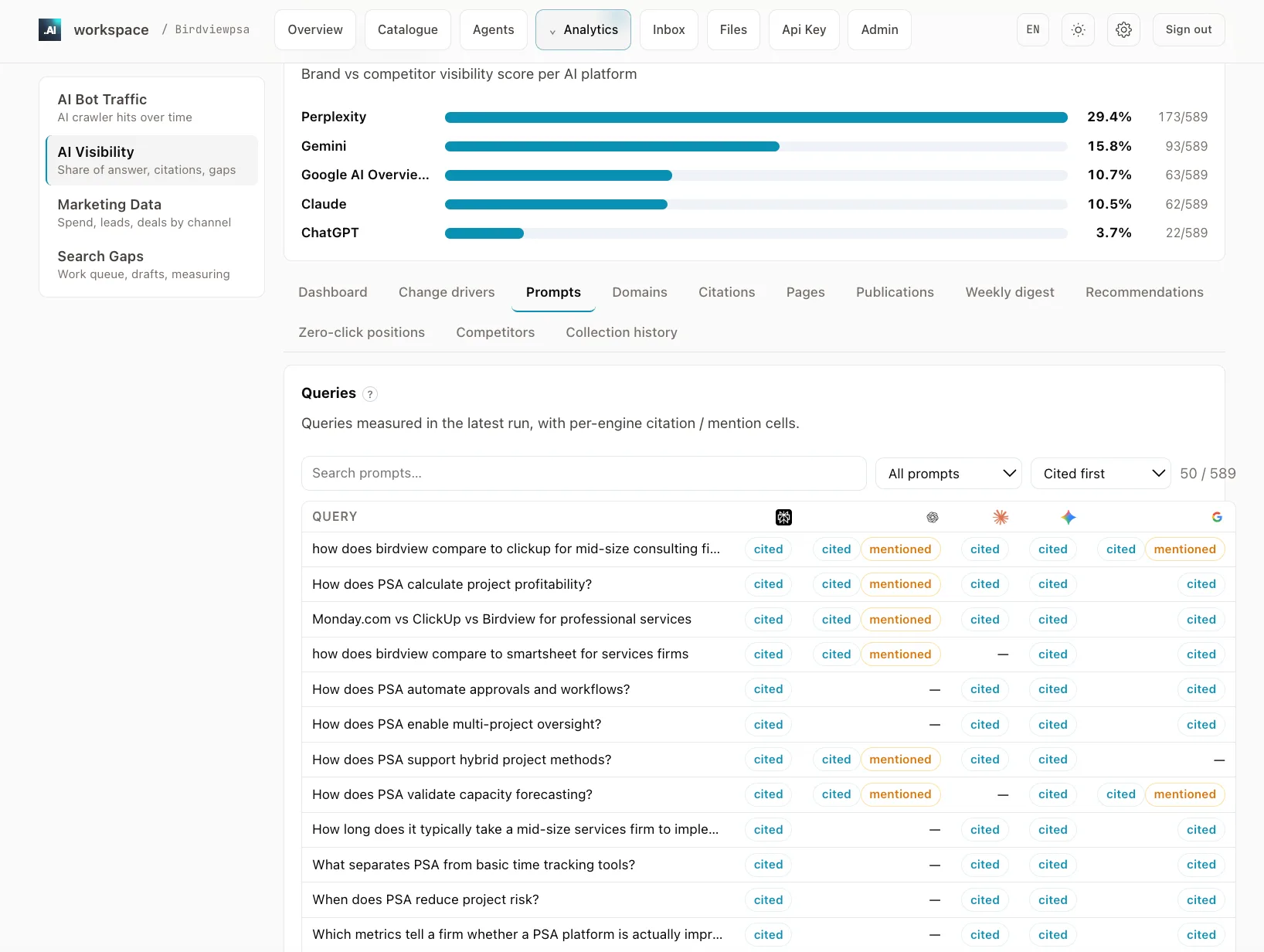
The mention/citation split is a data structure, not a footnote. Fifty of 589 tracked prompts shown. A cell reads cited when the engine exposed a source that supports the statement, and mentioned when the brand was named with no source behind it. Rows carrying both on the same engine are the interesting ones: the brand is in the answer, and something else is the evidence.
One run, five engines
The same brand is a different brand on every engine.
Workspace · AI Visibility
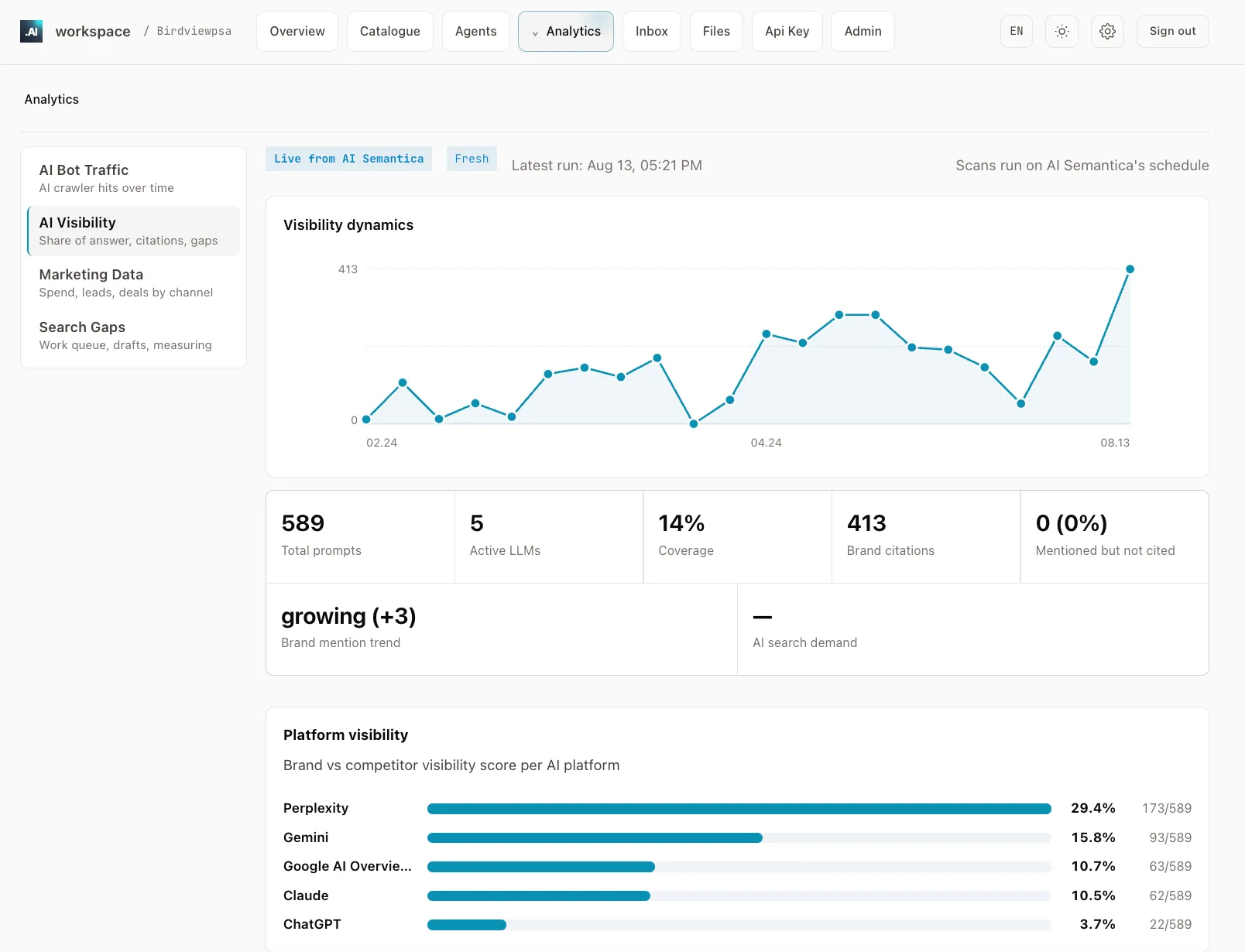
One run across 589 prompts and 5 engines. Perplexity 29.4% (173 of 589), Gemini 15.8% (93), Google AI Overviews 10.7% (63), Claude 10.5% (62), ChatGPT 3.7% (22). Coverage 14%, 413 brand citations, 0 mentioned-but-not-cited.
Blending those five into one number would report roughly 14% and hide the only decision worth making here — that the brand has an eight-fold gap between its best and worst engine, and the work that closes it is engine-specific.
Operating loop
Measure, interpret, hand off, then measure again.
- Declare the watch set. Approve the brand, competitors, prompts, engines, regions, languages, and observation window.
- Collect bounded observations. Preserve the response state and visible source links for each query.
- Normalize the evidence. Keep mentions, citations, sentiment, and unavailable responses as separate fields.
- Approve the next action. Turn only accepted opportunities into a content, publishing, distribution, or website handoff.
- Register the canonical URL. After publication, monitor the same prompt set at declared checkpoints without claiming causality from one observation.
Not measured
An empty panel says “not measured yet.” It does not say zero.
Workspace · AI Visibility · Dashboard
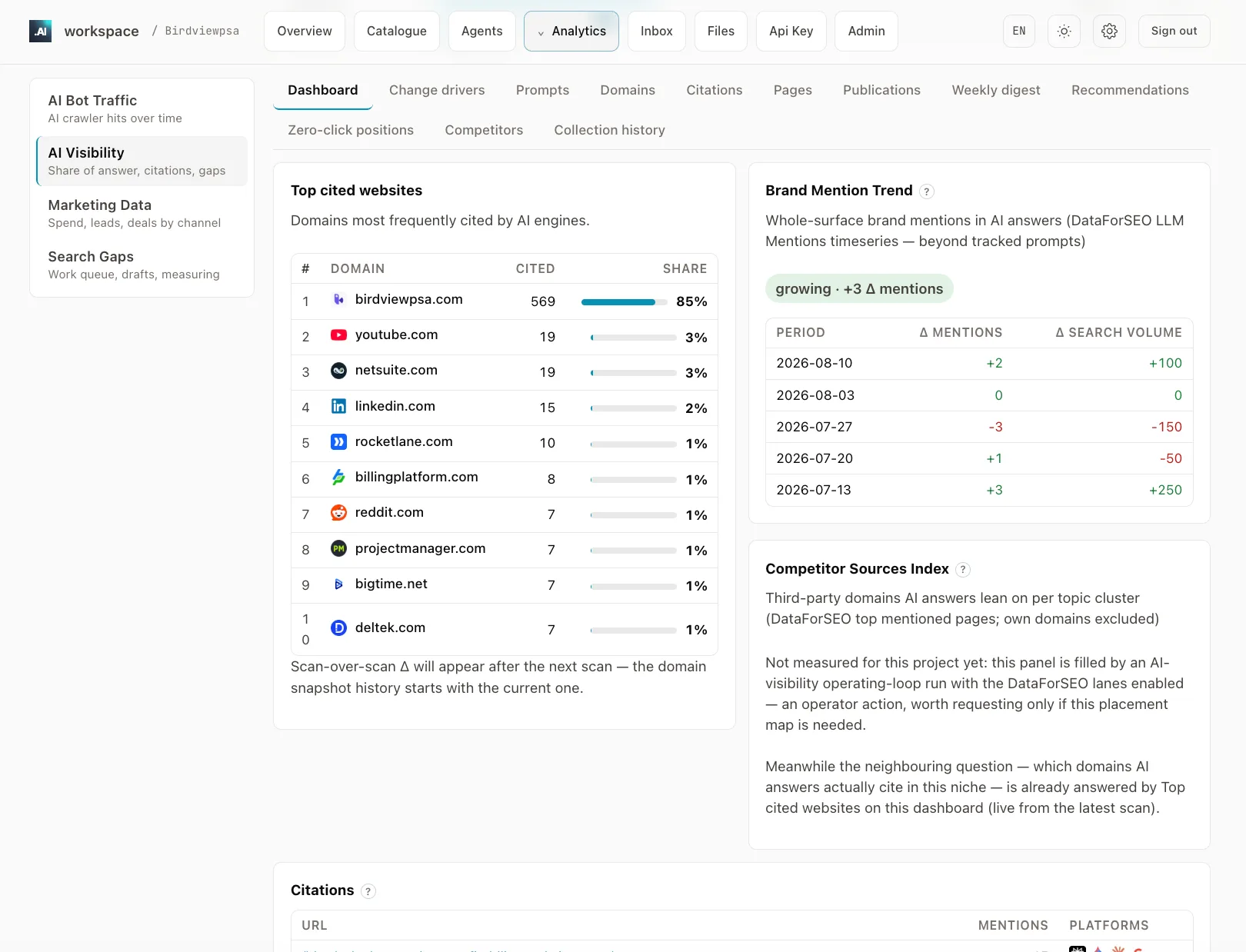
Absence of a reading is displayed as absence. The Competitor Sources Index panel carries no chart and no zero. It states that the measurement has not been run for this project, names the operator action that would fill it, and points to the neighbouring panel that already answers part of the same question from the latest scan.
This is the smallest visible piece of the loop and the one we would defend hardest. A dashboard that renders an unmeasured panel as 0% teaches its reader to act on a number nobody collected.
Why measurement first
Fixing is only possible when you measure.
“You can only fix what you measure.”
Why it works in practice: we measure humanswith.ai's own visibility with the same Hermes — nine answer engines, in English and Russian. First we see where the brand is absent, then ContentOS closes the gaps. A client gets the same loop.
Methodological basis — Greg Shevchenko's research on workspaces for AI agents: read on gregshevchenko.com.
Hermes FAQ
Measurement terms, kept honest.
What is Hermes?
Hermes is the observation layer for AI visibility. It collects prompt-and-engine responses, source links, mention state, citation state, and comparison context for an approved watch set.
What is AI Visibility Intelligence?
AI Visibility Intelligence is the decision layer nested under Hermes. It normalizes observations, separates citations from mentions, ranks opportunities, and creates governed handoffs for the next action.
Is a brand mention the same as a citation?
No. A mention says the brand appeared in an answer. A citation means the answer exposed a source that supports the statement. Hermes stores them as different signals.
Does Hermes guarantee that an AI engine will cite a page?
No. Hermes observes responses and source surfaces; it cannot control model answers. The loop uses repeated observations to decide what to investigate, publish, or repair next.
Can Hermes compare competitors?
Yes, when the approved watch set includes competitors. The comparison is based on the same prompts, engines, regions, and observation window so unlike measurements are not mixed.
What happens after an opportunity is accepted?
The decision layer produces a ContentOS-ready opportunity with the prompt, evidence, expected citation surface, acceptance criteria, and monitoring checkpoints.
Start with an observable question. Not a guaranteed outcome.
We will define a comparable watch set and show what evidence the workspace can preserve before proposing any production work.