Service · AEO / GEO · answer engines

AI search visibility: so AI answers name your brand, not a competitor.

When a buyer asks ChatGPT, Perplexity, or Gemini who to choose, the model replies with brand names. We make it name yours.

A growing share of your buyers skip the ten blue links. They ask an AI and get one answer built from a handful of sources. If your brand is not among them, you are invisible before the first click. That is the gap AEO and GEO close.


9 AI engines

  • ChatGPT
  • Claude
  • Perplexity
  • Gemini
  • Grok
  • DeepSeek
  • Kimi
  • Google AIO
  • Copilot

Where brands go wrong with AI search

Buyers know your brand. The AI answer leaves you out.

Across 2026 we measured visibility for dozens of brands, and the pattern repeats. One client had 127 mentions on branded queries and one on category queries. Buyers who already knew the brand were routed correctly. New buyers asking "which kitchen should I pick" were sent to competitors.

Where the visibility leaks. AI systems do not read the whole web on every query. They pull a short set of passages from a limited pool of sources and assemble an answer. If you are not in the pool, you are not in the answer. Getting into that pool is the whole job.

Workspace · AI Visibility · Domains

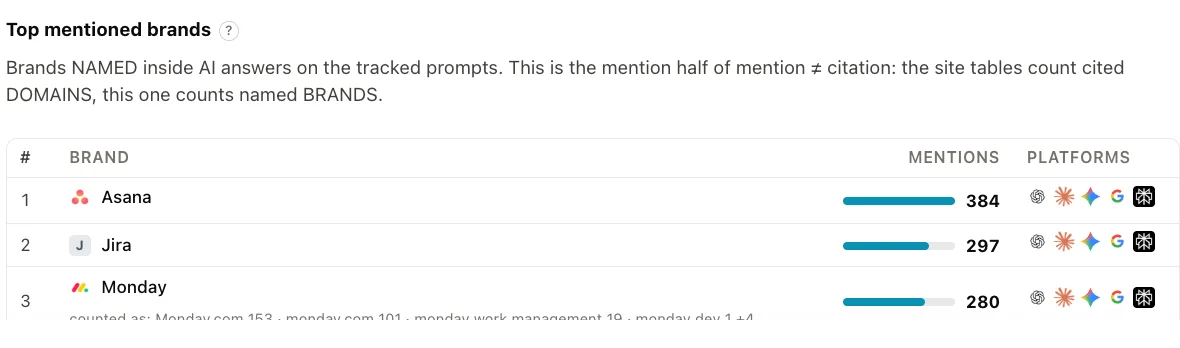
A workspace panel titled Top mentioned brands, listing which brands AI answers named on a tracked prompt set: Asana with 384 mentions, Jira with 297, Monday with 280, each with icons for the engines that named it.

The answer always names somebody. On one tenant's tracked prompt set the engines named Asana 384 times, Jira 297 and Monday 280. Those are competitors' names arriving in front of buyers who never typed them.

The panel also keeps a distinction most tools blur. This counts brands named in the answer text. That is not the same as domains cited as sources. A brand can be recommended without its site being the evidence, and it can be the evidence without ever being recommended. Work that closes one gap does not automatically close the other.


AEO

Answer Engine Optimization

AEO is content optimization for precise, citable answers. The content is shaped so an AI can lift a ready answer from it: clear definitions, structure, and facts with a source.

GEO

Generative Engine Optimization

GEO is your company's visibility inside the generative systems that synthesize an answer. Perplexity, Gemini, and Google AI Overviews build a reply from a small set of sources. GEO gets your brand into that set and into the final answer, on the queries that bring new buyers, not only branded ones.


Solution · the Marketing Agents platform

Five agents own the marketing responsibilities — inside a workspace of eighteen agents.

One Marketing Operator runs five agents: visibility analysis, content production and quality gates, canonical publishing and distribution, technical website readiness and verification and repeatable visual asset delivery. People keep strategy, claims, approvals and exceptions. Behind those five the workspace runs eighteen agents in total — support, control plane, and ops.

Agent 01 · measures · owns visibility analysis

Hermes Visibility

Comparable AI-visibility observations and governed opportunities.

Hermes preserves comparable observations and keeps mentions distinct from citations. AI Visibility Intelligence normalizes the evidence, ranks opportunities, and prepares the next governed handoff.

Open Hermes Visibility →

Agent 02 · produces · owns content production and quality gates

ContentOS

governed content packets with visible evidence.

ContentOS carries the prompt map, source boundary, draft, metadata, schema, checks, repair history, and human approval state together. Publishing authority stays in a separate product layer.

Open ContentOS →

Agent 03 · publishes · owns canonical publishing and distribution

Content Publisher

canonical-first publishing and bounded distribution.

Content Publisher preflights the destination, runs guarded publication, proves the live route, and keeps every approved channel adaptation connected by a visible source link.

Open Content Publisher →

Agent 04 · optimizes · owns technical website readiness and verification

Website Agentic Optimization

project-bound website changes with live proof.

The workflow can repair discovery, metadata, schema, links, layout, and performance within an approved scope. Passing CI remains human-review-required, and technical proof does not become a claim of causal attribution.

Open Website Agentic Optimization →

Agent 05 · designs · owns repeatable visual asset delivery

Visual Asset Studio

placement-specific visual assets with pixel proof.

Visual Asset Studio renders against an exact placement and verifies the final pixels before handoff. It does not invent a brand system or campaign concept when the brief is incomplete.

Open Visual Asset Studio →

13 more workspace agents run evidence gathering, client packaging, the control plane, and ops adapters. See the full platform →


How we work · a platform, not freelancers and an agency

We deploy the platform first. There is no shortcut.

A single agent that only monitors AI answers will not put you inside them. You need the whole production system: measurement, content, and site citability in one loop. We deliver it as a product you deploy, not a pile of freelancers and a monthly agency retainer.

  1. Deploy the platform

    Eighteen workspace agents under your brand. Five of them do the work you see: Visibility, ContentOS, Content Publisher, Website Agentic Optimization, Visual Asset Studio. This is the foundation — without it, single actions do not add up to a result.

  2. Audit and strategy

    Hermes maps your visibility across 9 engines. We find the category queries and the source gaps that block citation.

  3. Produce the content

    ContentOS runs each asset through nine quality gates. Content Publisher ships it. Website Agentic Optimization and Visual Asset Studio prepare the foundation and the visuals.

  4. Measure and grow

    A weekly report on your share of mentions in each AI. We adjust the strategy on the numbers, not on a hunch.

Workspace · AI Bot Traffic

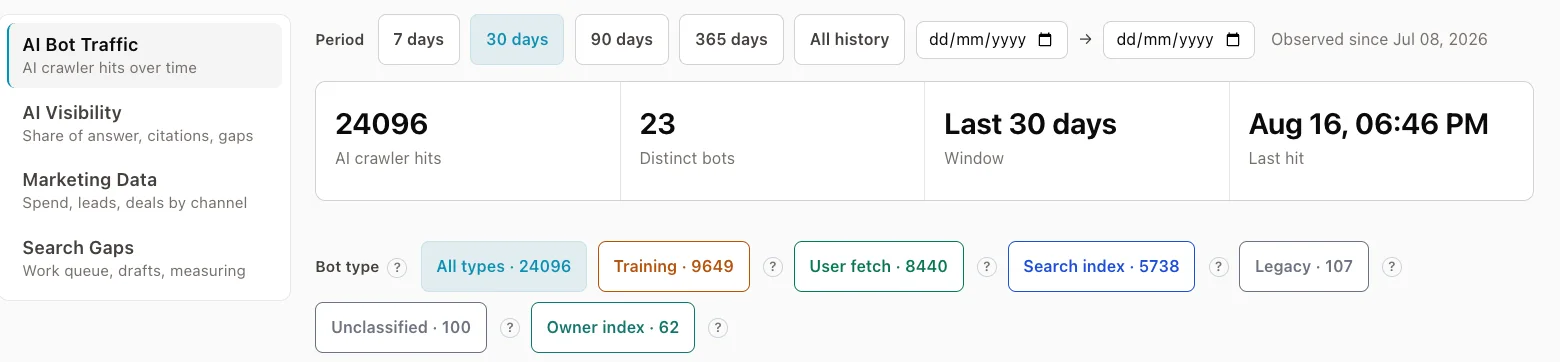
A workspace view of AI crawler traffic: 24,096 crawler hits from 23 distinct bots over 30 days, split into filter chips by why the bot came — training, user fetch, search index, legacy, unclassified, and owner index.

Before an engine can cite you, a crawler has to reach you — so that is measured separately. One tenant, 30 days: 24,096 hits from 23 distinct bots, split by why the bot came. Training 9,649, user fetch 8,440, search index 5,738, legacy 107, unclassified 100, owner index 62. Those six add up to 24,096 exactly — the split is a partition, not a sample.

The distinction earns its place. A training crawler may improve how a model describes your category months from now; a user fetch is a person's live question hitting your page right now. Reporting them as one “bot traffic” number makes the second invisible inside the first.


Why this works

We tested the approach on ourselves and on clients.

Humanswith.AI has worked in AI marketing since 2019. Here are the numbers from 2025 and 2026.


2 → 1,000+

On our own site. Citations in three months: 819 AI mentions and a 15.4% visibility share in our category.

9 / 9

GAC, auto retail (St. Petersburg). From full invisibility to mentions on all 9 platforms in 6 weeks. "Now ChatGPT recommends us by name."

×23

Birdview PSA, B2B SaaS. ChatGPT share rose from 0.9% to 21.5% in 8 weeks. Cited next to Monday.com, Asana, and Wrike.


The same account today · one denominator

Second of seven, and the reason is not citations.

The 21.5% above is a ChatGPT mention rate measured in one cluster of about a hundred prompts during the 8-week pilot. Everything below is the latest full scan on a much wider base — 589 prompts across five engines — so the two figures answer different questions. Both panels below share that single denominator.

Workspace · AI Visibility · Competitors

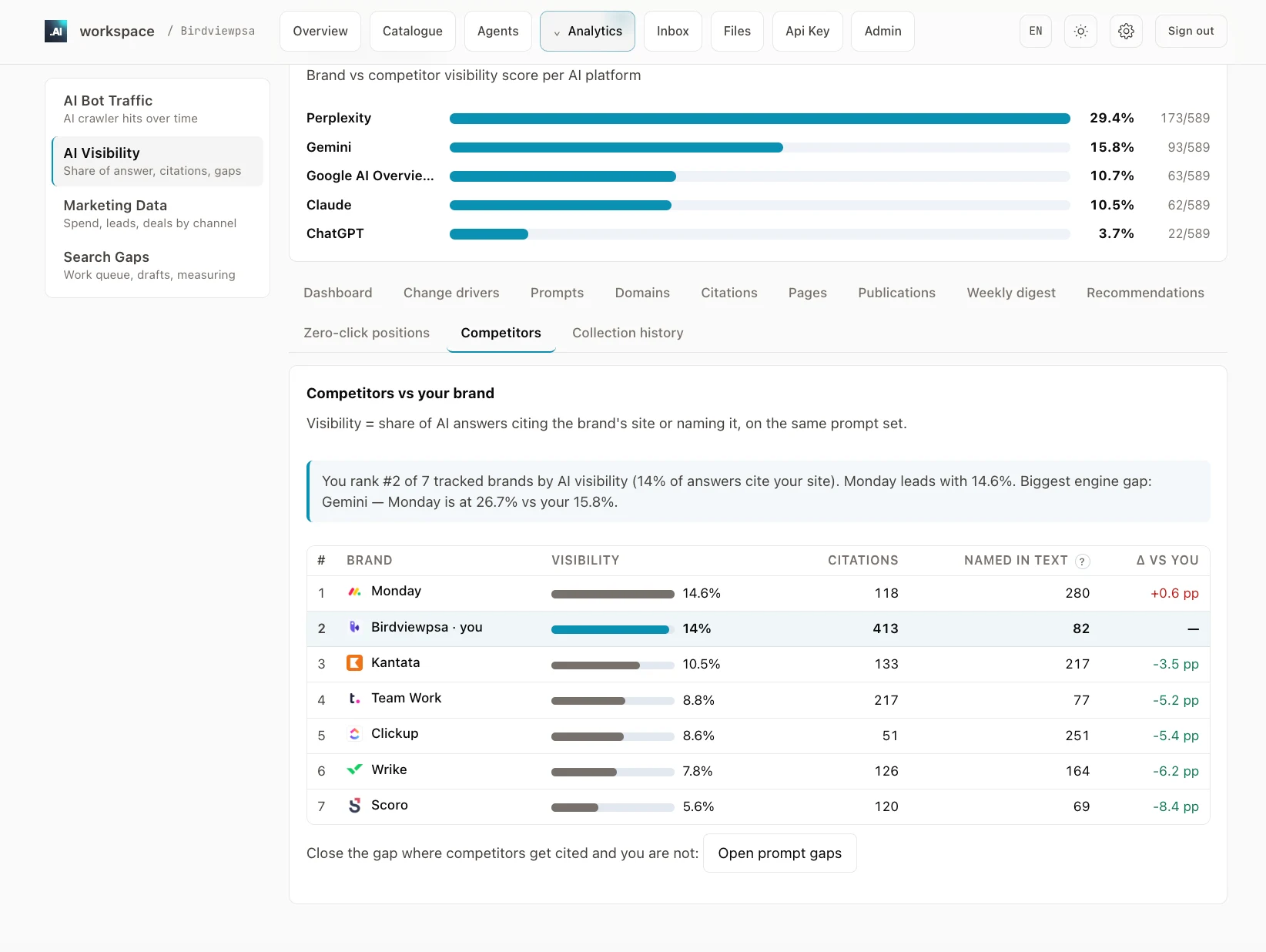
Workspace competitor table for Birdview PSA on the latest full scan: Monday first with 14.6% visibility, 118 citations and 280 namings; Birdview second with 14%, 413 citations and 82 namings; then Kantata 10.5%, Team Work 8.8%, ClickUp 8.6%, Wrike 7.8%, Scoro 5.6%.

Birdview is #2 of 7 tracked brands at 14%. Monday leads at 14.6%. We publish the row as it stands rather than the one that flatters us, because the interesting part is underneath the ranking.

Birdview has 413 citations to Monday's 118 — and Monday is named 280 times to Birdview's 82. Visibility here counts answers that cite the site or name the brand, so the brand that wins on evidence can still sit second on the combined number. Those two gaps close with different work: citations come from pages engines can use, names come from third-party pages that write the brand next to the category. The rest of the field: Kantata 10.5%, Team Work 8.8%, ClickUp 8.6%, Wrike 7.8%, Scoro 5.6%.

Workspace · AI Visibility · Zero-click positions

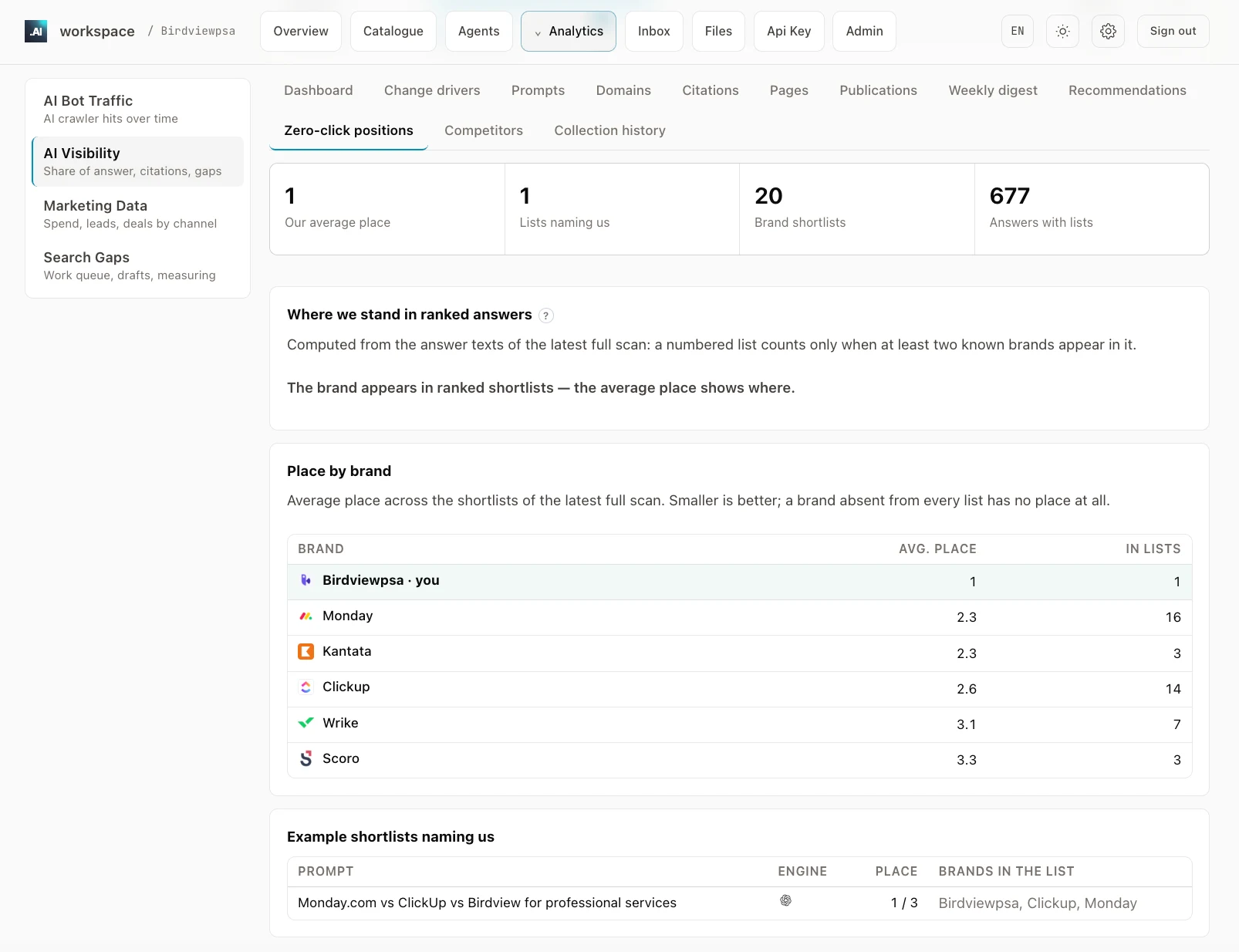
Workspace zero-click panel for Birdview PSA: average place 1, appearing in 1 list, out of 20 brand shortlists found in 677 answers with lists. Place by brand shows Birdview at 1 from a single list, Monday 2.3 from 16 lists, Kantata 2.3 from 3, ClickUp 2.6 from 14, Wrike 3.1 from 7, Scoro 3.3 from 3.

Birdview's average place in ranked shortlists is 1 — from exactly one list. Monday averages 2.3 across 16. Of the 20 brand shortlists found in 677 answers, Birdview appears in one of them.

An average over a single list is not comparable to an average over sixteen, and we would rather say so than print the 1 on its own. That is the honest shape of this account right now: strong where it is cited, thin where buyers ask for a ranked list. Shortlist slots are won by comparison pages, and that work is queued.


FAQ

AI search visibility, the short version.

How is AEO/GEO different from SEO?

SEO competes for a position in the list of blue links. AEO and GEO compete for a place inside the AI answer itself. Ask ChatGPT or Gemini who to choose, and it does not show a results page. It names a few brands from the sources it judged authoritative. Getting onto that shortlist is the goal.

How long until results show?

The first shifts in share of mentions usually show in six to eight weeks. Birdview PSA: ChatGPT share rose from 0.9% to 21.5% in eight weeks. GAC: from full invisibility to mentions across all nine platforms in six weeks. The exact timeline depends on your starting visibility and the competition in your category.

How do you measure whether AI is citing us?

The Hermes agent scans all nine engines every week against your target queries. It counts brand mentions and share of voice against competitors, then sends a report with the delta. You see numbers per engine, not promises.

Does this work across every AI engine, not just ChatGPT?

Yes. Generative systems build a reply the same way: they assemble it from a small pool of sources. Hermes scans nine engines: ChatGPT, Perplexity, Gemini, Claude, Grok, DeepSeek, Kimi, Google AI Overviews, and Microsoft Copilot. ContentOS then produces content that fits how each one cites.

Is this a tool or a done-for-you service?

It is a platform of marketing agents that we deploy under your brand and run as a service. A monitoring agent on its own will not put you inside AI answers. You need the whole production loop: measurement, content, publishing, technical fixes, and visuals. Eighteen workspace agents run under one operator — five Marketing Agents own the client-visible responsibilities (analyst, copywriter, content manager, SEO, designer). It is a product you run, not a pile of freelancers and a monthly agency retainer.

What does AI search visibility cost?

Plans start at $497/mo (Starter: audit, a monthly brief, three competitors tracked) and run up to a fully managed, done-for-you tier. The full grid and what each plan includes are on the pricing page.

What do you guarantee?

We do not promise a specific position. No honest agency controls AI answers directly. We guarantee transparent measurement across nine engines. We guarantee content that clears nine quality gates: facts, citability, E-E-A-T, schema. And we send a weekly report on the movement. You always see what you pay for.
Free visibility audit

See where AI names you, and where it names competitors.

We run your brand through Hermes across nine engines and send back a visibility map, free, before any call.

You see your share of mentions against competitors on the queries new buyers ask. You also see what to deploy to get into AI answers.