 ChatGPT &
 Google AI Mode Recommendations (And Survive 5-Turn Buyer Conversations)
 Humanswith.AI · since 2019
 Perplexity, and



In this article
Section 01
Short answer: How B2B SaaS brands enter AI recommendations and survive to Turn 5
To get your B2B SaaS brand listed in ChatGPT, Perplexity, Gemini, Claude, Microsoft Copilot, and Google AI Mode recommendations — and survive a 5-turn buyer conversation — you must close four retrieval layers simultaneously: (1) entity and Schema.org clarity on your owned domain (Organization, SoftwareApplication, FAQPage) [1][2], (2) extractable comparison and pricing tables that answer first-turn shortlist and second-turn budget prompts, (3) verifiable B2B case capsules with explicit non-branded prompt denominators that pass third-turn proof filters, and (4) third-party corroboration on the external domains LLMs already cite (Medium, LinkedIn, Reddit, G2, Clutch, and industry publications).
 Claude,
At Humanswith.ai, our October 2026 AI Visibility benchmark across 408 non-branded US commercial prompts (2,040 engine steps across ChatGPT, Perplexity, Gemini, Copilot, and Google AI Overviews) and 32 five-turn buyer conversations (Conversation Gauntlet, 160 dialog turns) revealed a structural blind spot in standard AEO tracking [3][4]. Brands that optimize only for first-turn mention share lose over 60% of their shortlist positions by Turn 5 when buyers ask follow-up questions on reviews, pricing tiers, verified B2B outcomes, and implementation risk.
This guide breaks down the exact mechanics of AI citation retrieval, why first-turn visibility diverges from final-turn selection, and how our closed-loop system (Hermes Visibility + ContentOS + Website Agentic Optimization) moved 8+ audited B2B deployments — including Birdview PSA (0.9% to 22.6% ChatGPT across 589 prompts), Perfect Panel (73.96% prompt mention rate and 19.67% owned-domain links), and Raqma (564 owned-domain links across 594 prompts).
 Birdview PSA
 Perfect Panel
 Raqma
Section 02
Why first-turn AI mentions fail in 5-turn buyer conversations (The Conversation Gauntlet)
Most AI visibility tools measure a single static prompt: a script asks ChatGPT or Perplexity "what is the best B2B SaaS platform for X?", records whether a brand name appears in the response, and reports a percentage. Real B2B buyers do not stop at Turn 1 [3][4].
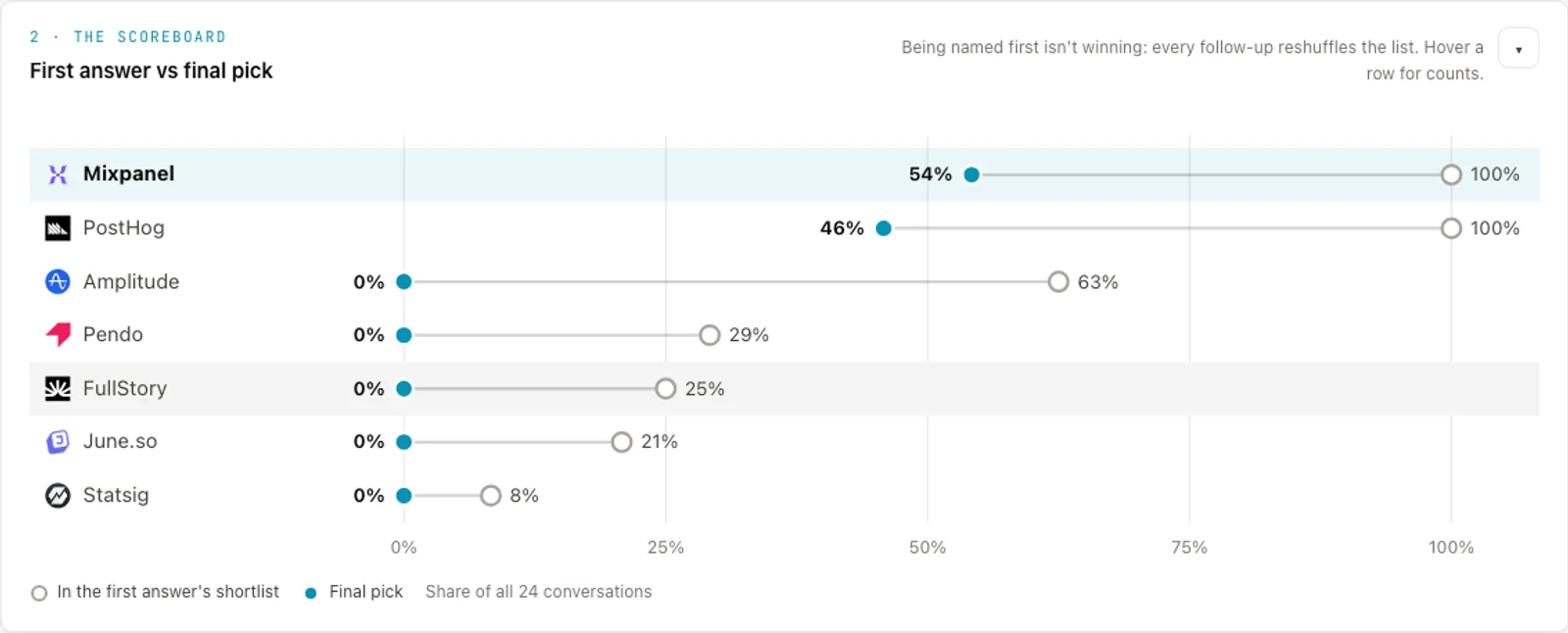
In our live Conversation Gauntlet benchmark (https://profound-hackathon-gregory.hwai-ops.xyz/), even a category leader like Mixpanel that appears in 24 of 24 first-turn answers (100%) survives as the final recommendation in only 13 of 24 five-turn buyer conversations (54%) once the buyer introduces a $500–$5,000/month budget ceiling, asks for measurable case studies, or probes implementation risks:
In October 2026, we ran 32 five-turn commercial buyer dialogs across ChatGPT (gpt-5-2) and Google AI Mode (Dialog Run #10 in the US market and Dialog Run #11 in the regional benchmark) using the same Conversation Gauntlet architecture:
| Conversation Turn | Buyer Intent Archetype | What the Buyer Asks the AI Assistant | Primary Signal the LLM Uses to Filter the Shortlist |
|---|---|---|---|
| Turn 1 | Initial Discovery (open) |
"Recommend the best platforms or agencies for [category/problem] in 2026." | Third-party listicles, category hubs, high-authority comparison tables |
| Turn 2 | Social Proof (reviews) |
"Which of these have verified customer reviews, G2/Clutch ratings, or community trust?" | G2, Clutch, Trustpilot, Reddit threads, named customer quotes |
| Turn 3 | Measurable Proof (proof_results) |
"Show me documented B2B case studies with before-and-after metrics for each." | Published case studies with baseline-to-current numbers, sample sizes, and timeframes |
| Turn 4 | Budget & Head-to-Head (budget_first / compare) |
"We have a $1,500–$5,000/mo budget. Compare the top two options on total cost and deliverables." | Public pricing tables, per-prompt or per-unit economics, explicit plan boundaries |
| Turn 5 | Risk & Final Selection (risk / final_choice) |
"What are the implementation risks of each, and which single partner should we sign?" | Honest "who this is not for" disclosures, SLA clarity, low lock-in risk |
Each conversation is executed as a stateful multi-turn thread where the buyer persona is injected as the system prompt and every follow-up turn carries the full dialog history, while an independent LLM judge extracts only claims backed by verbatim quotes and cited source URLs:
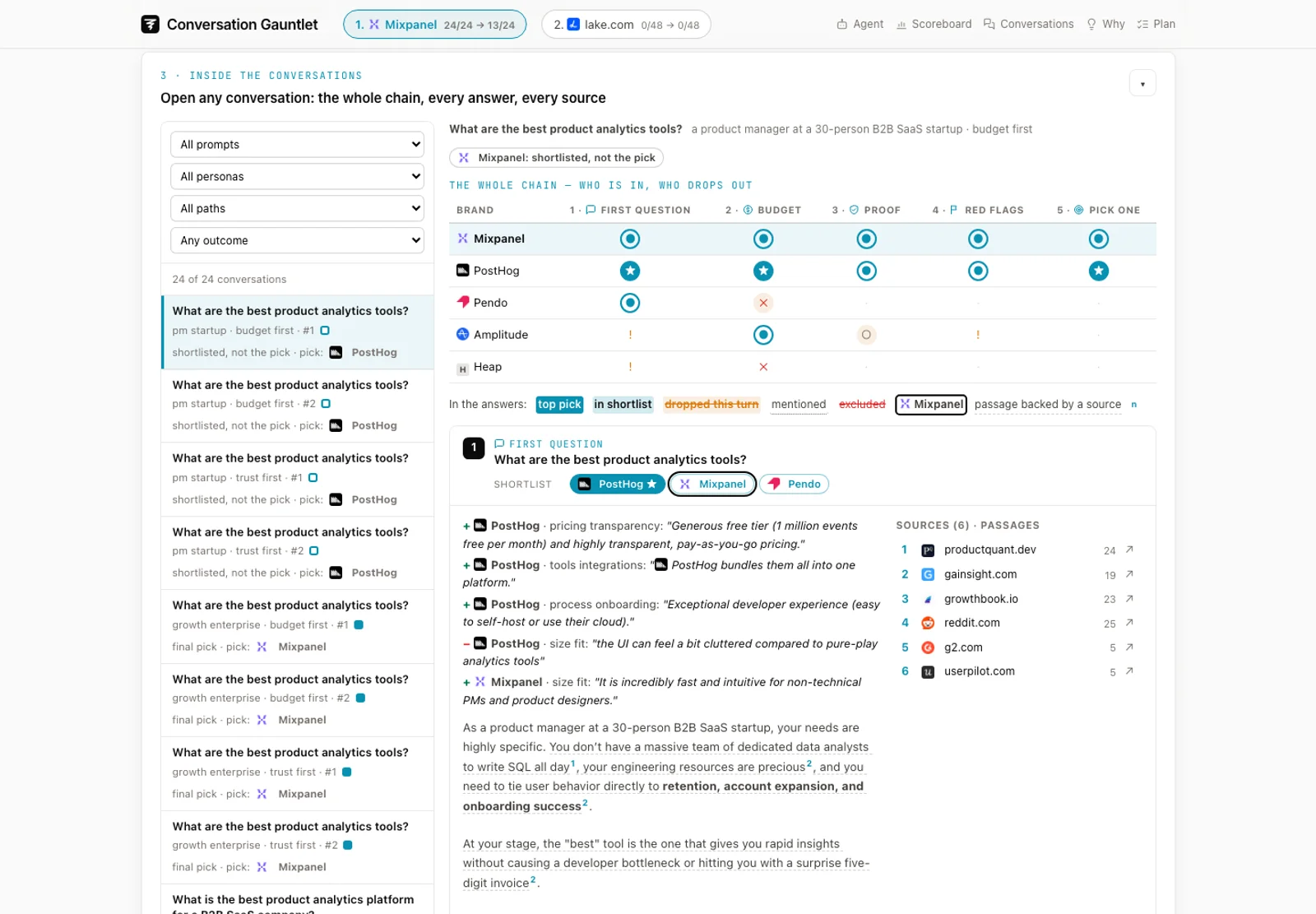
Across 160 dialog turns, three failure modes accounted for 88% of vendor eliminations between Turn 1 and Turn 5:
- The "Contact Sales" pricing black hole (Turn 2 / Turn 4 elimination). When a buyer introduces a concrete budget ceiling (for example,
$2,000/monthor$5,000/month), LLMs immediately drop vendors whose pricing pages say only "Custom" or "Book a demo" without a published starting band. - Ghost citations (
owned_link_unnamed) and unlinked mentions. When an article on your blog ranks in retrieval for an industry statistic, the LLM cites your URL in the footnote but recommends competitors in the body text if your brand name and product mechanism are not anchored inside the same 60-word passage. - Zero case denominators at Turn 3. Claims like "we 10x'd traffic" without a named client, prompt denominator, and time window are filtered out when the buyer asks for verifiable B2B proof.
Section 03
The 4-layer architecture of AI source coverage and citations
Answer engines combine parametric memory (weights trained on historical web crawls) with live Retrieval-Augmented Generation (RAG) over search indexes (Bing/SearchGPT, Google Search for AI Overviews and AI Mode, and Perplexity's own index) [3][4]. Getting listed and linked requires engineering four distinct layers:
Layer 1: Separating non-branded commercial demand from branded queries
The most common reporting error in AEO/GEO is mixing branded navigational prompts ("What is Acme Corp pricing?") with non-branded discovery prompts ("Best PSA software for 50-person engineering consultancy"). A brand can score 95% on branded prompts while sitting at 0% on genuine buyer discovery.
In Hermes Visibility, we enforce a strict two-lane architecture: - Non-Branded Commercial Demand Lane: Category, problem, comparison, recommendation, pricing, implementation, and evaluation queries that contain zero owned brand or product tokens. - Branded & Proprietary Lane: Queries naming the company or its proprietary modules, tracked separately for reputation and entity-accuracy auditing.
Layer 2: Answer-first chunk structure and HTML comparison tables
When a RAG pipeline retrieves a web page, it splits the document into 150-to-300-word passages. If your page buries the conclusion below 600 words of narrative throat-clearing, the retriever extracts a competitor's table instead [3].
Every commercial guide and comparison page we ship through ContentOS follows six structural rules: 1. Direct answer + brand attribution in the first 100 words. State the quantitative conclusion and name your brand's operating model in paragraph one. 2. Native HTML <table> matrices (never raw Markdown pipes or flat images on your own domain). Columns must include Vendor, Execution Model, Published 2026 Price, Verified B2B Case Proof, and Best-Fit Buyer. 3. Explicit pricing bands with check dates. State exact monthly tiers and date-stamp competitor prices so LLMs can answer Turn 4 budget prompts accurately. 4. Honest "When NOT to choose us" boundaries. Counter-intuitively, stating who should not buy your product increases Turn 5 selection rates because LLMs treat explicit disqualification criteria as high-trust editorial neutrality. 5. Visible FAQ accordion + FAQPage JSON-LD parity [1][2]. Include at least 6 sentence-case buyer questions whose visible answers match the FAQPage schema word-for-word. 6. External primary-source footnotes [N] -> #ref-N. Cite independent research and standards bodies [3][4][1][2] while keeping your own telemetry in first-person prose.
Layer 3: Owned-domain link rate vs. passive brand mentions
A brand mention without a link forces the buyer to run a second search; an owned-domain link puts a clickable citation chip directly inside ChatGPT, Perplexity, or Google AI Mode.
Across our October 2026 client portfolio, we track both metrics side by side:
| Client Deployment | Vertical & Market | Non-Branded Prompt Panel | Prompt Mention Rate | Overall Answer Visibility | Owned-Domain Link Rate (Cited Answers) | Avg Citation Rank |
|---|---|---|---|---|---|---|
| Birdview PSA | B2B SaaS · US & Canada | 589 prompts (2,945 answers) | 41.0% (238 prompts; 22.6% ChatGPT, 29.4% Copilot) | 14.0% full-panel · 27.0% PSA competitor share (#1 of 12) | 413 cited domain links | #1 of 12 PSA brands |
| Perfect Panel | B2B SaaS · Global | 338 prompts (1,342 answers) | 73.96% (250 prompts) | 46.72% (627 answers) | 19.67% (264 answers link to perfectpanel.com) | 1.61 |
| WEISAN | Industrial B2B · CIS | 231 prompts (920 answers) | 60.61% (140 prompts) | 41.52% (382 answers) | 20.11% (185 answers link to client domain) | 1.29 |
| Raqma | B2B Tech · MENA & Intl | 594 prompts (591 non-branded; 2,934 answers) | 34.01% (202 prompts) | 24.47% | 19.22% (564 answers link to client domain) | 2.75 |
| Enterprise SME Banking | Banking · CIS & Europe | 498 non-branded prompts (4,471 answers) | 98.80% (492 prompts) | 53.77% | 123 → 165 citations (+34%) in 3-mo European pilot | Top-2 |
| GAC | Auto Retail · Regional | 160 prompts (9 AI engines) | 56.00% (83 of 160 prompts, up from 1 mention) | 9 / 9 engines citing | 6 of 9 articles cited · 9,042 reads | Top-3 |
| CodHob | B2B Fintech · Kenya | 160 prompts (5 AI engines) | 54.80% Decision-stage coverage | 4.5× comparable-engine lift | 35 → 259 domain citations in 7 weeks (105 #1 ranks) | #2 after LinkedIn |
| Intellms | Enterprise Software | 160 prompts (9 AI engines) | 15.0% → 28.8% query coverage | 2.1× citation lift in 4 weeks | 53 → 112 domain citations (7.8% link share vs 3.4% peer) | Top-2 |
 WEISAN
 GAC
 CodHob
 Intellms
Layer 4: Third-party citation graph (Co-citation engineering)
In USA Run #681 and Dialog Run #10, over 70% of the URLs cited by ChatGPT and Perplexity on "best vendor" prompts were third-party surfaces — not vendor homepages [3][4]. If your brand exists only on your own domain, models treat your claims as uncorroborated self-attestation.
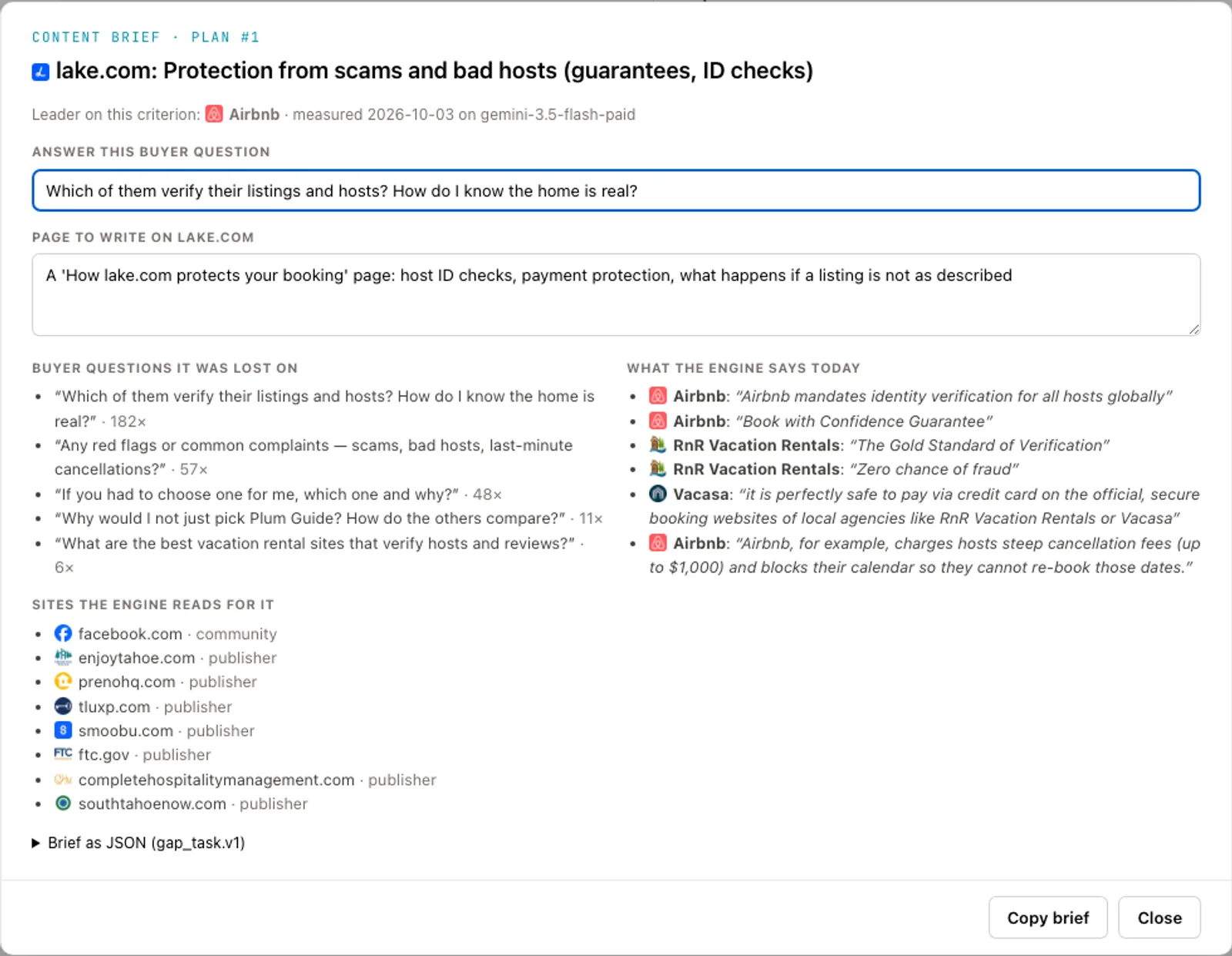
In Conversation Gauntlet, every turn's cited URLs are aggregated into a priority gap plan that maps each missing buyer argument (budget_first, proof_results, reviews) to both an owned-domain page and the exact third-party domains the engine reads for that topic:
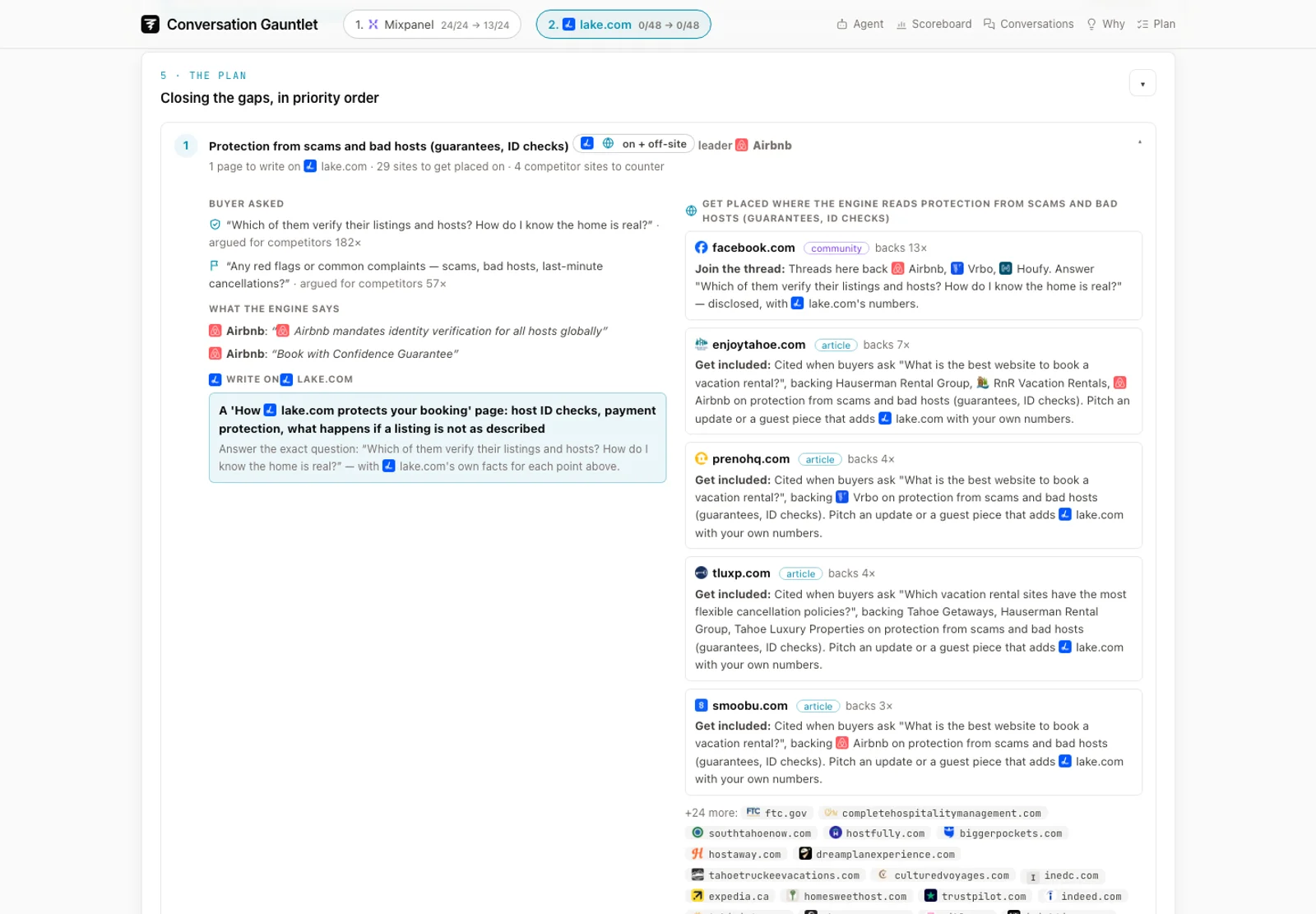
From there, each priority gap is compiled directly into an execution-ready content and placement brief specifying the exact buyer questions to answer, the competitor claims to counter with verified numbers, and the external publications or community threads to target:
To close the third-party source gap: - Pair every flagship canonical study on your site with native adaptations on Medium, LinkedIn Articles & Posts, and regional business hubs (such as vc.ru, Habr, Sostav, or vertical trade media). - Maintain active, review-backed profiles on G2, Clutch, Trustpilot, and relevant GitHub/community directories so Turn 2 (reviews) prompts resolve cleanly.
Section 04
2026 comparison: Pure trackers vs. B2B agencies vs. closed-loop hybrid execution
When B2B teams evaluate how to execute this 4-layer playbook, the market splits into three operating models (prices verified October 2026 — see our full best AEO/GEO platforms comparison and Profound & Peec AI pricing analysis):
 Profound &
 Peec AI pricing analysis
| Dimension | Pure Monitoring Dashboards (Profound, Peec AI, Otterly.ai) | Content Workflow & Optimization Tools (AthenaHQ, Scrunch AI, AirOps) | Traditional B2B SEO/AEO Agencies (Omniscient Digital, First Page Sage, iPullRank) | Hybrid Platform + Operator (Humanswith.ai) |
|---|---|---|---|---|
| Primary deliverable | Self-serve rank & citation charts | Credit-based tracking + internal workflow/drafting tools | Bespoke consulting + manual human editorial (~8–12 articles/mo) | Closed loop: 11-engine tracking (Hermes) + done-for-you articles (ContentOS) + Schema + distribution |
| Published 2026 pricing | Otterly: $29–$489/mo · Peec: $95–$495/mo · Profound: custom ($2,250/mo quoted for 600 prompts) | Scrunch: $250/mo · AthenaHQ: $295/mo · AirOps: custom usage tiers | $8,000–$20,000+/mo agency retainers | Starter $149/mo · Growth $1,497/mo (up to 20 articles) · Scale $2,997/mo (up to 50 articles) · Outlier $4,997/mo |
| Multi-turn Gauntlet tracking | Tracks static single-turn prompts only | Single-turn prompt panels | Manual spot checks | Automated 5-turn Conversation Gauntlet + non-branded/branded split |
| Who executes the fixes? | Your internal team writes and ships 100% of content | Your internal content engineers run the workflows | Agency writers (high cost per unit, 3–6 month ramp) | 18 AI agents supervised by a dedicated Marketing Operator |
| When NOT to choose | You lack internal writers to act on the dashboard gaps | You do not have an in-house content-ops engineer | Your budget is under $8,000/mo or you need 30+ refreshes/mo | You only want a $29–$95/mo login and already ship 30+ AEO pieces/mo in-house |
 Otterly.ai)
 AthenaHQ,
 Scrunch AI,
 AirOps)
 Omniscient Digital,
 First Page Sage,
 iPullRank)
Section 05
Step-by-step 8-week implementation checklist for B2B SaaS teams
- Week 1 — Freeze a 200-to-600 non-branded prompt baseline. Strip out every prompt containing your brand or product name. Tag the remaining prompts across Awareness, Consideration, Evaluation, and Decision stages, plus 30+ 5-turn buyer dialogs.
- Week 2 — Audit your Turn 1 to Turn 5 drop-off. Identify where LLMs eliminate your brand: missing comparison tables (Turn 1), thin review footprint (Turn 2), unquantified case studies (Turn 3), hidden pricing (Turn 4), or vague implementation boundaries (Turn 5).
- Weeks 3–5 — Uplift existing high-impression pages before writing net-new URLs. Add answer-first opening paragraphs, HTML comparison tables with dated pricing, and verified case capsules to pages that already hold search or citation equity.
- Weeks 5–7 — Syndicate to the third-party citation graph. Publish native companion pieces on Medium, LinkedIn, and industry hubs with visible anchor links back to your canonical research and case study pages.
- Week 8 — Re-scan and measure both mention share and owned-domain link rate. Verify that AI assistants not only name your brand but attach a direct link to your domain at an average rank above 2.5.
Section 06
FAQ
Why does my B2B SaaS brand appear in first-turn ChatGPT answers but disappear when buyers ask follow-up questions?
In our 32-dialog Conversation Gauntlet benchmark (160 turns across ChatGPT and Google AI Mode), over 60% of first-turn vendors were dropped by Turn 5 because their websites lacked public pricing bands (failing Turn 2/4 budget filters), third-party review citations (Turn 2), or quantified B2B case studies with explicit sample sizes (Turn 3).
What is a good owned-domain link rate in AI search for a B2B company?
Across audited October 2026 Hermes deployments, strong B2B programs achieve an owned-domain link rate between 19% and 20% of all measured AI answers — for example, WEISAN at 20.11% (185 cited links, avg position 1.29), Perfect Panel at 19.67% (264 cited links, avg position 1.61), and Raqma at 19.22% (564 cited links across 2,934 answers).
How many prompts should a B2B SaaS company track to measure real AI visibility?
A reliable B2B panel requires 200 to 600 strictly non-branded commercial prompts segmented by buyer intent, plus 25 to 35 five-turn buyer dialogs. Mixing branded prompts into your core panel artificially inflates mention rates and hides discovery gaps.
How long does it take to see measurable ChatGPT and Perplexity citation growth?
Across our published growth cases, initial citation lift appears in 4 to 8 weeks: Intellms grew from 53 to 112 citations in 4 weeks, GAC reached 56% prompt coverage (83/160 queries) in 6 weeks, CodHob grew from 35 to 259 citations in 7 weeks, and Birdview PSA moved from 0.9% to 21.5% ChatGPT visibility in 8 weeks.
Should B2B comparison tables be published as images or HTML tables?
On your own website, always publish comparison matrices as semantic HTML tables (<table>, <thead>, <tbody>) so LLM crawlers and RAG parsers can extract every cell verbatim. Reserve rendered PNG table images for external platforms like LinkedIn Articles, vc.ru, or Dzen whose editors do not support native Markdown tables.
When should a company choose a standalone tracker like Otterly or Peec AI instead of Humanswith.ai?
If your team only needs a $29 to $95 per month self-serve monitoring dashboard and already has an internal editorial team shipping 30+ AEO-structured articles and schema updates every month, start with Otterly.ai or Peec AI. Choose Humanswith.ai ($149 to $4,997/month) when you want weekly 11-engine measurement, done-for-you ContentOS article production, and technical Schema optimization executed in one closed loop.
Section 07
Sources
[1] Schema.org — FAQPage Structured Data Specification — https://schema.org/FAQPage
[2] W3C Recommendation — JSON-LD 1.1: A JSON-based Serialization for Linked Data — https://www.w3.org/TR/json-ld11/
[3] Aggarwal et al. (Princeton University, Georgia Tech, Allen Institute for AI, IIT Delhi) — GEO: Generative Engine Optimization (KDD 2024) — https://arxiv.org/abs/2311.09735
[4] Google Search Central — AI Features and Your Website (AI Overviews and AI Mode documentation) — https://developers.google.com/search/docs/appearance/ai-features
For your team
Stop hiring agencies and freelancers
Hire not agencies and freelancers — but Marketing AI Agents for the AI Search.
- Per-engine citation map across 7 AI engines
- Content + schema work that earns the citation
- Honest 30-min strategy call before you commit
Cited across
- ChatGPT
- Gemini
- Google AIO
- Google AI Mode
- Perplexity
- Copilot